

Author name: pyrops

Warehouse Management System

Multimodal Logistics: How Digital Integration Is Reshaping Indian Logistics

The logistics landscape has been undergoing a profound transformation. Once dominated by fragmented road-based transport and paper-heavy processes, the sector is rapidly moving toward a multimodal, digitally enabled ecosystem that promises to cut costs, improve efficiency, and position the country as a global logistics hub. This shift isn’t just about adding rail, coastal shipping, and air transport alongside trucks; it’s about using digital integration to knit these modes together into a seamless, transparent, and intelligent supply chain network. The Rise of Multimodal Logistics in India Multimodal logistics refers to the coordinated use of multiple modes of transport such as road, rail, air, and waterways to move freight efficiently from origin to destination. Traditionally, Indian logistics has been heavily skewed toward road transport, which, while flexible, can be cost-intensive and inefficient for long-distance or bulk shipments. The shift to multi modalism is driven by a combination of infrastructure development and supportive government policies. For instance, reforms under the National Logistics Policy (NLP) and the ambitious PM GatiShakti Master Plan are accelerating the creation of integrated transport networks that connect ports, airports, rail terminals, inland waterways, and road corridors. These initiatives aim to reduce logistics costs currently around 13–14% of GDP to single digits by 2030 by promoting seamless cargo movement across different modes of transport. Digital Platforms: The Backbone of Integration At the heart of this shift is digital integration. Unlike conventional systems where data is siloed across stakeholders transporters, port authorities, customs, shippers, and regulators, India is building unified platforms that bring disparate data streams together in real time. One of the flagship initiatives is the Unified Logistics Interface Platform (ULIP). This digital backbone integrates data from logistics-related ministries and departments, enabling real-time tracking, predictive insights, and visibility across the supply chain. With over hundreds of millions of transactions handled daily, ULIP is reducing bottlenecks and empowering businesses with accurate delivery forecasts and inventory planning. which provides real-time container tracking and multimodal visibility, a boon especially for exporters and MSMEs needing reliable data to manage global supply chains. Technologies Driving Transformation Digital integration spans several emerging technologies that are reshaping how logistics operations are planned and executed: Artificial Intelligence (AI) and Machine Learning: These tools enhance decision-making by analyzing transport patterns, optimizing routes, and forecasting demand. AI-based predictive routing improves delivery reliability and reduces idle times. Internet of Things (IoT): Sensors attached to vehicles, containers, and warehouse equipment provide continuous data feeds, enabling real-time tracking and preventive maintenance. Blockchain: Secure, immutable ledgers boost transparency and trust, especially in multimodal freight where multiple parties interact. Smart contracts can automate compliance and documentation, reducing delays. Cloud and Big Data Analytics: These technologies enable scalable data storage and powerful analytics, helping companies respond quickly to disruptions and optimize asset utilization. Impact on Efficiency and Competitiveness The confluence of multimodal infrastructure and digital integration is already yielding measurable benefits. Real-time visibility helps businesses manage inventories better, reduce buffer stocks, and improve overall supply chain responsiveness. Paperless workflows such as e-way bills and digital customs clearances expedite transit and cut down on administrative delays, especially at inter-state and international borders. Moreover, as rail’s share in freight movement grows and dedicated freight corridors come online, India is poised to significantly lower logistics costs and transit times. Projections suggest logistics cost could fall to 7–8% of GDP by 2035, making Indian goods more competitive both domestically and globally. Challenges and the Road Ahead Despite the momentum, challenges remain. The logistics ecosystem involves thousands of small operators who may lack the resources to adopt advanced technologies. Ensuring interoperability across platforms, maintaining cyber-security, and scaling digital literacy across the sector are ongoing priorities. Still, the direction is clear: multimodal logistics powered by data, connectivity, and automation is reshaping India’s logistics narrative. By leveraging digital platforms to seamlessly orchestrate multiple transport modes, India is not only improving operational efficiency but also unlocking new opportunities in global trade and economic growth. As infrastructure and technology continue to evolve hand in hand, the Indian logistics sector stands on the cusp of becoming a digitally integrated, globally competitive engine of economic transformation.
Warehouse Management System

Invisible Inventory Loss: The Hidden Gaps in Your Warehouse Operations

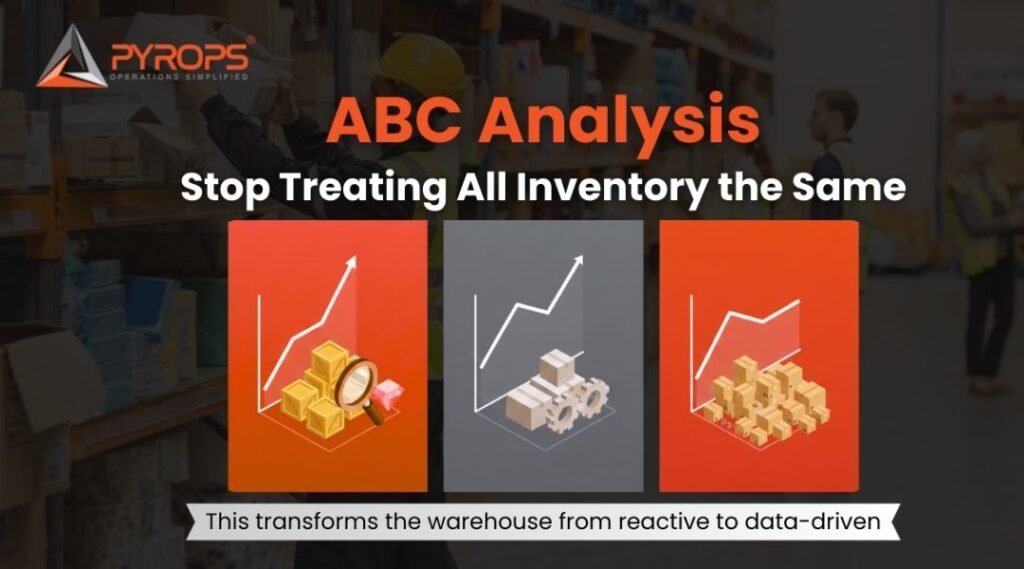
Not all inventory deserves the same attention — yet most warehouses still manage every SKU as if it carries the same risk and value. This is one of the biggest hidden causes of working-capital loss, slow picking, and excess stock. ABC inventory analysis addresses this by clearly indicating where time, space, and money should be allocated. Rather than spreading effort evenly, ABC inventory management concentrates resources on the SKUs that actually drive revenue, service levels, and cash flow. What is ABC Inventory Analysis? ABC analysis of inventory is a method of ranking SKUs based on their business impact — usually a combination of sales value, usage frequency, and revenue contribution. It groups items into three classes: Class % of Items % of Inventory Value Nature A 10–20% 70–80% High value / fast moving B 20–30% 15–25% Medium importance C 50–60% 5–10% Low value/ slow moving This form of ABC classification in inventory management reveals a critical truth: a small number of SKUs control most of the warehouse’s financial and operational impact. A-items need precision, visibility, and tight control. C-items need cost-efficient storage and simple handling. B-items sit between the two Why ABC Analysis in Inventory Matters in Warehousing Without ABC inventory management, warehouses fall into inefficient patterns: High-value items get stored next to dead stock Fast movers are buried behind slow-moving SKUs Pickers walk longer distances for critical orders Stock counts take too long and miss the riskiest items When everything is treated equally, the warehouse becomes slow, expensive, and error-prone. With ABC classification in inventory management: A-items are placed close to dispatch and high-speed pick zones B-items get moderate control and accessible storage C-items move to high-density or bulk locations This reduces travel time, protects revenue-critical inventory, and prevents over-control of low-value stock. How WMS Enables ABC A modern WMS makes ABC inventory analysis automatic and continuous. Instead of manually assigning classes, the system: Analyzes order frequency, velocity, and sales value Applies ABC analysis of inventory at SKU and location level Reclassifies products as demand shifts Aligns storage layout, pick paths, and cycle-count rules accordingly For example: A fast-selling SKU that becomes a top revenue driver is promoted to A-class A slow-moving item drops to C-class and is moved to cheaper storage This allows ABC inventory management to stay aligned with real demand, turning the warehouse from a reactive operation into a data-driven system. Conclusion ABC inventory analysis brings structure to what is otherwise chaotic inventory management. By using ABC analysis of inventory, warehouses gain clear visibility into which SKUs deserve the most attention, space, and control. Instead of spreading effort evenly across thousands of items, ABC inventory management ensures that time, money, and resources are focused where they generate the highest return. With Pyrops WMS, this becomes a living, automated system. Pyrops WMS continuously applies ABC inventory analysis using real-time movement and sales data, dynamically reclassifying SKUs as demand changes. If you want to reduce picking time, gain tighter control over your inventory, and overall have smooth functioning operations, reach out to us now! Book a demo now!   Read More   Read SCM New.

Warehouse Management System

AI cannot fix operational chaos. It amplifies operational maturity.

Artificial Intelligence is no longer a futuristic concept in warehousing. It is already influencing how modern warehouses plan inventory, allocate work, optimize picking, predict delays, and improve accuracy. The real question is no longer “Should we use AI?” — it is “Are our operations ready for it?” Because AI cannot fix operational chaos. It amplifies operational maturity. AI Starts with Data Most warehouses still operate with fragmented data: AI is only as good as the quality of data it receives. If the system does not know where inventory actually is, no AI model can magically optimize operations. That is why the journey toward AI usually begins with operational digitization: Without this foundation, AI becomes expensive guesswork. Where AI Is Already Helping Warehouses 1. Smarter Inventory Planning AI can analyze historical movement patterns, seasonality, and demand fluctuations to improve replenishment and stocking decisions. Result: 2. Intelligent Picking Optimization Modern systems can dynamically optimize pick paths based on: This reduces travel time and increases throughput. 3. Labour & Resource Planning AI can predict peak loads and recommend: Instead of reacting to volume spikes, warehouses can prepare proactively. 4. Exception Prediction AI can identify operational anomalies before they become major issues: This improves control and reduces operational surprises. But Here’s the Reality… Many businesses jump directly to “AI strategy” conversations while still struggling with: AI is not the first step. Operational visibility is. A warehouse running on WhatsApp coordination and spreadsheet reconciliation cannot suddenly become “AI-enabled.” The Real Competitive Advantage The biggest value of AI in warehousing is not robotics or futuristic automation. It is decision-making speed. Warehouses generate massive operational data every day. AI helps convert that data into actionable insights faster than humans can manually analyze. Businesses that prepare early will gain: Final Thought AI will not replace warehouse teams. But warehouses using AI-assisted decision-making will outperform those that don’t. The winners will not necessarily be the companies with the most advanced technology. They will be the ones with the cleanest processes, best operational discipline, and strongest data foundation. The future warehouse is not just automated. It is intelligent. The question is — is your warehouse ready? Book a demo now! Read More Read SCM New.

Case Studies

Case Study – Driving Compliance and Visibility with Pyrops WMS for a Multi-Client 3PL

Case Study – Driving Compliance and Visibility with Pyrops WMS for a Multi-Client 3PL Delivered end-to-end compliance and high-accuracy operations for a multi-client 3PL by automating serial tracking and warehouse workflows. Read more case studies   Thank you for Signing Up Download Case Study   Please correct the marked field(s) below.Name *1,true,1,Name,2Company Name *1,true,1,Company Name,2Contact Email *1,true,6,Contact Email,2Contact No. *1,true,8,Contact No.,2**Required Fields Note: It is our responsibility to protect your privacy and we guarantee that your data will be completely confidential.

Scroll to Top